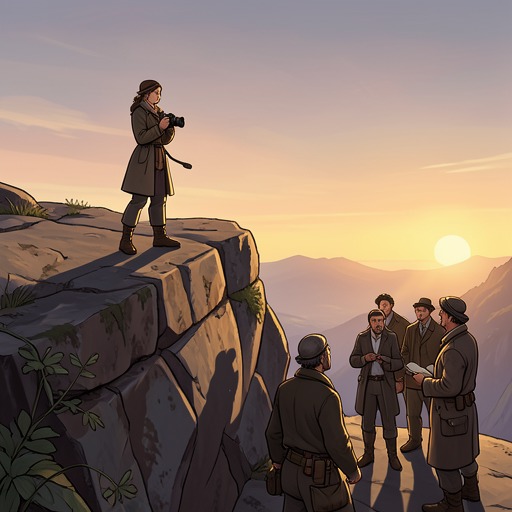
Clifftop Diversion and Attempt to Photograph the Plans
Black Box (Jennifer Egan Edition)Clifftop Diversion and Attempt to Photograph the Plans is a covert operation in which a staged alarm is meant to draw a host away from sketches long enough for the agent to photograph them. The diversion succeeds, but the photograph does not: a flash exposes the attempt, blinds the agent, and ends with the Designated Mate’s footsteps receding downhill. The scene makes the operation’s fragile bargain plain: attention can be redirected, but the agent’s safety depends on remaining useful to people whose interests may not coincide.
Opportunity and Preparations
The scene begins with a practical warning: when two people start making sketches, concrete planning may have begun. The drawings therefore matter not merely as marks on a page but as evidence of activity the agent is meant to capture. The objective is specific, and the opportunity is narrow: the sketches must fill the camera’s field of vision while their user is distracted.
The agent’s equipment is built into the body. The camera implanted in the left eye is operated by pressing the left tear duct; in poor light, a flash can be activated by pressing the outside tip of the left eyebrow. Those instructions establish the physical mechanics of the attempt before the scene tests them. They also include a crucial safeguard: the non-camera eye should be covered when the flash is used, because the flash can temporarily blind it. The manual further warns against using flash photography in other people’s presence. The later failure is thus not a mysterious malfunction but a consequence the instructions have already made legible.
The Diversion
To draw attention away from the sketches, the agent springs up with a gasp and peers toward the house. The gesture directs other people’s attention outward; the apparent sound gives the agent a momentary authority because only the agent seems to have heard it. The Designated Mate presses for an explanation, and the agent waits until that eagerness approaches anger before faintly reporting, “I heard screaming.” The delay is part of the tactic: the alarm is made compelling by withholding its supposed cause.
The host is the first to head toward the alleged screaming. That response creates the opening the operation needs, but the Designated Mate’s behavior complicates the apparent success. A glance toward the dock may indicate that the Mate’s interests are not fully aligned with the host’s, while attention to a handset may signal that the distraction has begun to disrupt the transaction the agent meant to record. The diversion has moved people, but it has not secured their cooperation or kept events under control.
The Photograph Fails
With the sketches in view, the agent relies on the hope that the handset’s backlit screen will distract its user from a flash at some distance. The prescribed technique is to move close enough for the sketches to fill the field of vision and then hold still. Yet the hope about the screen proves misplaced. The user reacts with an epithet in another language and asks, “What the fuck was that?” The response makes the mistake immediate: the handset had not absorbed the user’s attention as completely as the agent assumed.
The flash produces bright, throbbing total blindness because the non-camera eye was not covered. The safeguards therefore frame the failure twice over: other people are present, and the agent has neglected the protection intended to prevent the flash’s consequence. Rather than accept responsibility for the flash in front of the others, the agent cries, “I can’t see!” The claim is true, even as it distances the agent from the act that caused the danger. The attempt to obtain an image of the plans yields no reported photograph; instead, the failed capture turns the agent’s body into the scene’s central liability.
Abandonment Below the Cliff
Blindness makes the next movement perilous. The agent is on a clifftop promontory, and the Designated Mate forcefully yanks their hand while they are trying to navigate at speed. Cooler air and a downward slope indicate that they have passed below the cliff’s edge. On the crumbling, wooded path, blindness and heels soon lead the agent to trip and collapse.
The decisive consequence arrives as sound: the Mate’s footfalls recede downhill. The instructions read that departure as evidence that the agent has overtaxed their limited value to the Mate. The agent is left sitting in the dirt, helplessly disoriented and unable to do much more. What began as an effort to capture someone else’s plans ends in a sharp reversal: once the agent cannot reliably move or help, the person who pulled them along leaves them behind.
Narrative Function
The event’s instructional voice turns action into a sequence of tactical cues and bodily consequences. A gasp, a glance, a delayed answer, a press at the eyebrow, and receding footsteps all serve as evidence for the agent to interpret. This procedural form gives small gestures operational meaning, but it also exposes the limits of treating people and danger as manageable signals. The host can be redirected; the Mate’s divided attention can be noticed; neither observation guarantees control.
The scene’s central reversal is between successful distraction and failed extraction of information. The scream sends the host away, yet the attempt to photograph the sketches exposes the agent and disrupts the transaction. The flash’s brightness becomes blindness; the Mate’s forceful assistance becomes abandonment. By ending with the agent stranded below the cliff, the episode makes the cost of the failed photograph concrete and recasts the Mate’s attention as conditional rather than protective.